
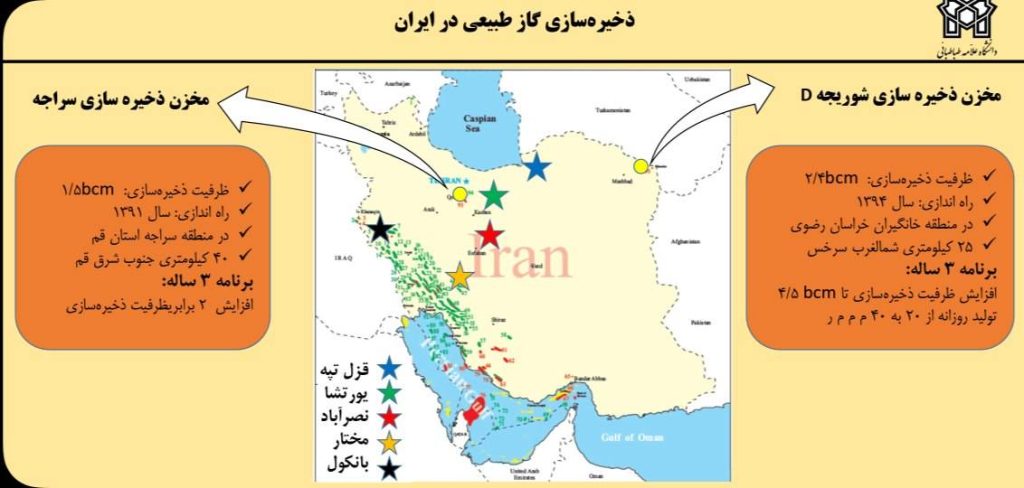
🔹According to 2021 statistics, there are about 693 active natural gas storage reservoirs worldwide, of which Iran owns two — Serajeh and Shourijeh. Gas storage, aimed at energy security and compensating for gas supply–demand imbalances, is a key concern for both gas-producing and gas-consuming countries.
🔹 The legislator, in the Seventh Development Plan, has stipulated that at least 10% of gas consumption during the plan’s implementation period must be supplied from storage.
🔹 Based on available data, Iran ranks second globally in proven gas reserves (OGIP), third in production, and fourth in natural gas consumption. However, past policy decisions and performance on the demand side, along with a lack of diversification in the energy consumption mix, have resulted in consumption levels growing so large that nearly all production is absorbed domestically, despite increases in output.
📊 [Comparison of Iran’s Gas Consumption with China]
To illustrate the extraordinary scale of Iran’s gas consumption, it is noteworthy that despite a 16-fold difference in population, a roughly 49-fold difference in economic size, and other significant disparities between the two countries—which make such a comparison inherently questionable—Iran’s gas consumption is still approximately 63% of China’s.
🔹 Even with such a rough comparison, it is evident that Iran’s gas consumption pattern is far removed from global trends.
🔹 Alongside other measures such as demand management and energy efficiency, natural gas storage can help partially offset the current supply–demand imbalance.
👉 The following section provides an overview of natural gas storage for further understanding in Persian
Leave a Reply