
(A Non-Technical Summary)
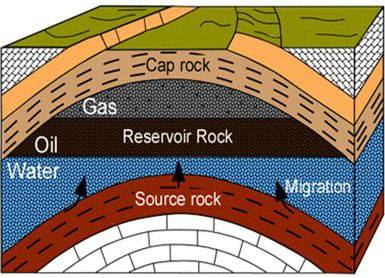
A petroleum system* refers to an active source rock and the accumulation of hydrocarbons that are chemically linked to that source rock. A petroleum system consists of the geological *elements and processes that control the formation, migration, accumulation, and preservation of hydrocarbons.
 Key Elements of a Petroleum System
 Source Rock
The source rock must preserve organic matter and prevent its oxidation. Therefore, it is typically very fine-grained and deposited in a reducing environment—such as continental shelves or calm aquatic settings.
Reservoir Rock
A reservoir rock is a rock capable of storing hydrocarbons. The most important properties of reservoir rocks are porosity and permeability, which allow hydrocarbons to be stored and flow within the formation.
Cap Rock
A cap rock is an impermeable layer that prevents hydrocarbons from escaping the reservoir. The more impermeable and less brittle the cap rock is, the more effectively it seals and retains hydrocarbons, preventing their upward migration and loss at the surface.
Traps
After hydrocarbons are generated in the source rock, they migrate upward through permeable layers. They may reach the surface unless a barrier halts their movement. This barrier forms a trap. Traps include structural, stratigraphic, and combination types, which will be discussed in more detail later.
Main Processes in a Petroleum System
 Maturation (Maturity)
Organic matter accumulated in the source rock must be exposed to heat and pressure over geological time to generate hydrocarbons. Maturation occurs in the following stages:
 Stage 1: Diagenesis
Occurs during and shortly after deposition in shallow aquatic environments at depths of several hundred meters. Sediments compact, lithify, and approach chemical equilibrium.
Stage 2: Catagenesis
At temperatures of ~50–160°C and pressures of ~300–1200 atm, kerogen begins to crack, generating hydrocarbons. Early products include heavy oils, followed by lighter oils, and ultimately wet gas and condensates in the late stage.
Stage 3: Metagenesis
This final transformation stage occurs at higher temperatures (approximately 175–225°C) and greater burial depths. Hydrocarbon generation is dominated by methane, with residual carbon left behind from the breakdown of remaining kerogen.
Migration
Hydrocarbon migration occurs in two phases:
*Primary migration: Movement of generated hydrocarbons from the source rock into the first permeable layer, typically the reservoir rock.
*Secondary migration: Movement and accumulation of hydrocarbons within the reservoir rock toward a trap.

Leave a Reply